Research Projects
Project 01: Microlensing Object high-Resolution Imaging Analysis (MORIA)
At NASA Goddard, I'm working with Dr. Sean Terry to develop an automated image analysis pipeline, MORIA. MORIA is an automated procedure to reduce high-resolution HST images of microlensing targets, build empirical point-spread function models from the data, and perform simultaneous multi-star PSF fitting to blended sources, lenses, and neighbor stars.
MORIA can extract lens and source properties from crowded-field images, enabling quick characterization of lens and source stars. The upcoming Roman GBTDS will produce high-resolution images for thousands of microlensing targets. With appropriate modifications to accommodate the characteristics of the Roman Wide-Field Instrument (WFI), MORIA can be adapted as a pipeline for Roman microlensing target analysis. It will help determine constraints on the lens flux and lens-source proper motion, breaking microlensing degeneracies.
I have tested MORIA on the follow-up HST observations of the microlensing event KMT-2019-BLG-0253. The event was originally published by Hwang et. al (2022). MORIA's multi-PSF fitting routine found a new star in the system (Star 2 in the image)!
P.S. While the IAU does not allow me to name this "new" star, I did give it a nickname: "Kronkondile." It's based on this YouTube video that someone once shared with me.


Project 02: Modeling Binary Objects in the Bayesian Analysis of Gravitational Lensing Events (BAGLE) Python package.
Since 2023, I have worked as a researcher at UC Berkeley's Moving Universe Lab (under the guidance of Dr. Jessica Lu) to add new binary models with orbital motion to a microlensing package called BAGLE. I also added binary models with fewer parameters that describe the binary orbital motion as accelerated, linear, or stationary motion of the secondary companion; these are useful when the orbit has a very low eccentricity or the orbital period is much longer than the microlensing timescale. The model parameterizations based on these binary lensing equations enable joint-fitting of photometric and astrometric datasets. These binary models will be used to fit microlensing event data from the Vera C. Rubin Observatory, the Nancy Grace Roman Telescope, and other surveys. Currently, I am working on adding triple lenses to BAGLE.
I've put my favorite figure from the research on the right. It's a centroid-shift map that helps visualize the region where we expect the lensed and unlensed source positions to differ most.
Under the figure, there are two animations:
-
The first is a small animation showing the movement of two binary lenses and a single source moving across the sky. The animation includes the lensed images to show the impact of the binary lenses on the source's astrometric positions.
-
The second is a finite-source, binary-lens event with orbital motion. I've also highlighted the caustics/critical curves. These are regions in the source and lens planes (respectively) where the source's amplification approaches infinity.
I also have a tattoo on my left arm of Sisyphus pushing a piece of bagel up the slope :)


Project 03: BHL Accretion in Orion Source I
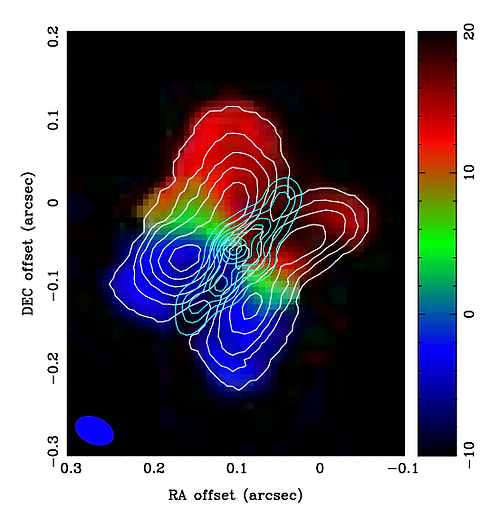
In my freshman and early-sophomore years at UC Berkeley, I worked on a short project with Dr. Melvyn Wright to develop a 3D kinematic model to fit the velocity profiles of several compounds in the disk-driven, rotating, bipolar outflow of Orion Source I. We calculated a BHL rate for accretion onto Orion Source I and predicted that the disk is being depleted on a timescale of 200-2000 years.
The figure on the right traces water emission. The color scale maps the water emission over a velocity range of -10 to +20 km/s. The white contours map the moment-0 velocity image of water emissions between -20 and +30 km/s, and the blue contour is the disk's 99 GHz continuum emission. You can also see the velocity gradient along the disk's major axis in the emission, indicating the direction in which the disk is rotating.
Project 04: Data Analysis for the B612 Foundation.
I did two separate projects with the B612 Foundation. One of them was to optimize the Precovery algorithm used to identify asteroid observations, and the other was to correct inconsistencies in observation times for asteroids’ orbit data submitted from the NOIRLab Source Catalog (NSC) to the Minor Planet Center (MPC).
I did these projects as a freshman, wanting to try my hand at data science.
